Post
Release day
A signed tag starts everything else: two builds, the checksum file and the release page. Eight seconds of it, looped.
1 min
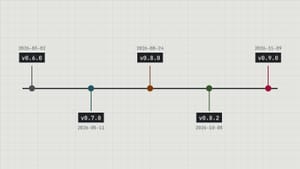
Release notes, newest first. Each one says what to change before you upgrade.
Post
A signed tag starts everything else: two builds, the checksum file and the release page. Eight seconds of it, looped.
1 min
Changelog
Pegel refuses a config that asks more probes to agree than it has. The release job writes checksums after every build has finished.
pegel check now refuses a config whose agree is larger than the number of probes. In 0.9.0 such a config started without a word and could never alert, because one probe cannot agree with itself. Two people ran into it in the first three days, both on a Raspberry Pi with a single probe.Fixed
agree = 2 and one [[probe]] started and never fired an alert. pegel check and pegel run stop and name the line to fix.[[probe]], agree defaults to 1 again, as the notes of 0.9.0 said.pegel probe retried a refused token every second. It waits 30 seconds between attempts now and logs why.Changed
SHA256SUMS after the last build has finished. Details in the checksum incident.probes := max(1, len(cfg.Probes))
if cfg.Defaults.Agree > probes {
return fmt.Errorf("%s line %d: agree = %d needs %d probes, found %d",
cfg.Path, cfg.Line("defaults.agree"), cfg.Defaults.Agree, cfg.Defaults.Agree, probes)
}$ pegel check --config pegel.toml
error: pegel.toml line 3: agree = 2 needs 2 probes, found 1
Post
Alert routes, DNS checks and a container image for the probe come next. A plugin system, a hosted Pegel and an app do not.
1 min
Incident
For 13 hours after the release, pegel upgrade on arm64 stopped with a checksum error. The binary was fine, the checksum file was not. Two community packages still carry the old one.
Monitoring
Major
From the release at 18:04 CET on 2026-11-09 until 07:25 the next morning, The release job had no order between building and publishing. For 0.8.2 the arm64 build happened to finish first. For 0.9.0 it failed once on a runner that lost its network, restarted, and finished four minutes after the checksums were out. Nobody downloaded an arm64 binary that evening to check, so the first person to notice was a reader the next morning. The packages of two community distributions copied the checksum file within the first hour. Until their maintainers update them, installing from those packages fails the same way. The files on our downloads page are correct, and this check proves it on your machine:pegel upgrade on arm64 stopped with "checksum mismatch". The binary was fine. The checksum file next to it held the hash of an arm64 build that the release job had cancelled and started again, because the job wrote SHA256SUMS as soon as it could. amd64 was not affected.Timeline
SHA256SUMS lists the hash of the cancelled arm64 build.pegel upgrade on a Raspberry Pi stops with "checksum mismatch".SHA256SUMS signed and uploaded. pegel upgrade on arm64 works again.What went wrong
What we changed
SHA256SUMS (in 0.9.1).pegel upgrade prints both hashes on a mismatch, so a report tells us at once which file is wrong.Still open
$ sha256sum -c SHA256SUMS --ignore-missing
pegel_0.9.0_linux_arm64.tar.gz: OK
Changelog
An alert fires only when two probes agree, which ends the false alarms from a flaky home line. Since this release, interval counts seconds.
Checks can now run from two places at once, and an alert only fires when both see the outage. That ends the false alarms from a flaky home connection, which were most of our bug reports this year. The one breaking change is The probe on the second machine gets its checks from your Pegel and needs no config of its own, only the name and a token. Why two probes, and what a year of false alarms looked like: Why an alert needs two probes.interval, which counts seconds now instead of minutes. Pegel refuses to start with an old config and says which line to fix.⚠️interval counts seconds, not minutes. Multiply every interval in pegel.toml by 60 before you upgrade, or Pegel will not start.Added
[[probe]] in pegel.toml and the command pegel probe, which runs your checks on a second machine and reports to your Pegel.agree under [defaults] or per check: how many probes must see an outage before an alert fires. It defaults to 2 with two probes or more.Changed
interval is in seconds. interval = 1 meant one minute and now means one second, which Pegel refuses.pegel check names the probes each check ran from.Removed
PEGEL_CONFIG, deprecated since 0.7.0. Use --config.Fixed
Upgrading from 0.8.x
 [defaults]
-interval = 1
+interval = 60
+agree = 2
+
+[[probe]]
+name = "home"
+
+[[probe]]
+name = "vps"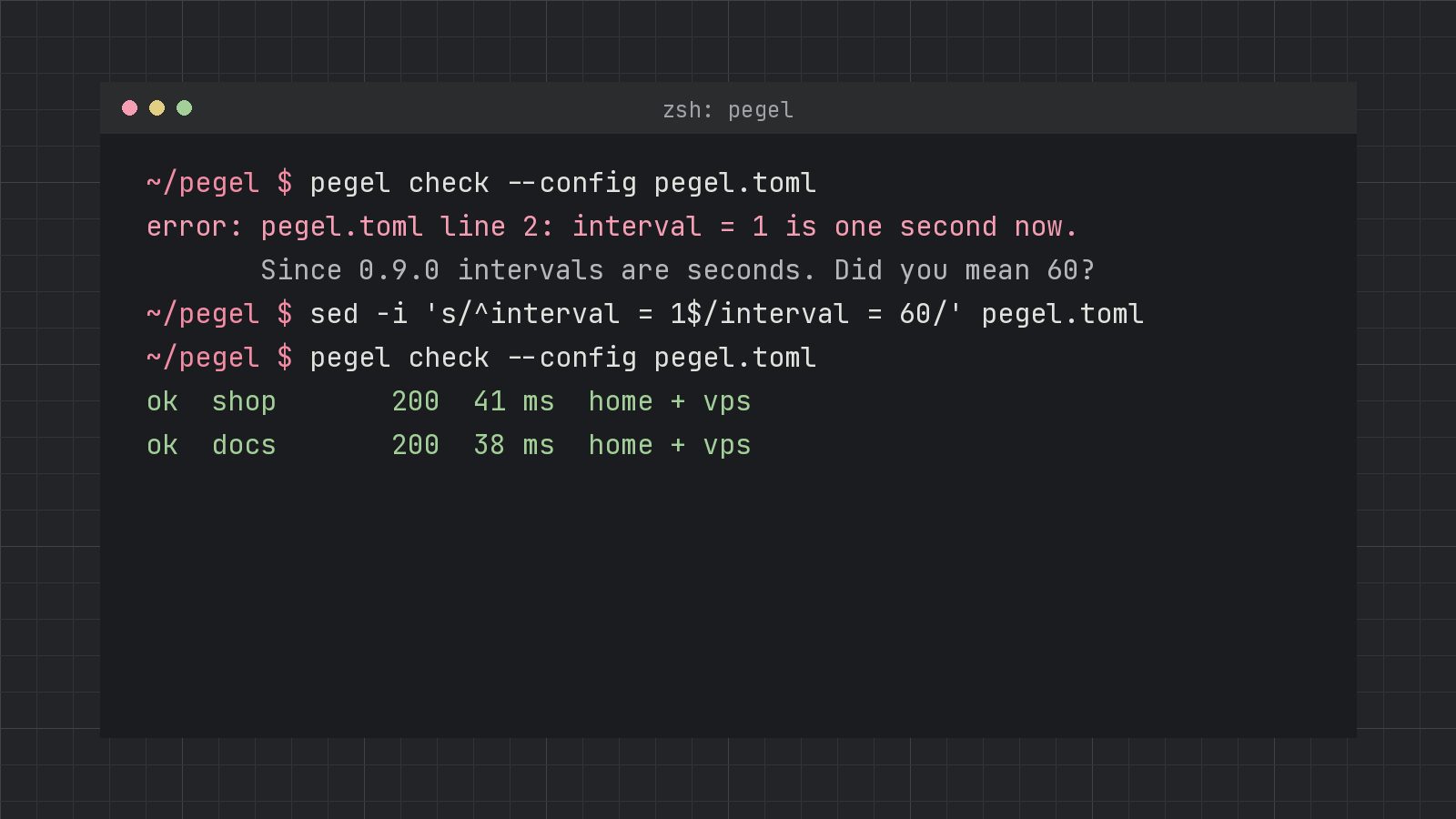
Changelog
At log level debug, 0.8.0 wrote webhook URLs with their tokens to the log. Upgrade if you log at debug. There is no v0.8.1.
Pegel no longer writes webhook URLs to its log. At There is no v0.8.1. We tagged it on 2026-10-02, its arm64 build failed, and by the time that was fixed the security fix above was ready too. From this release on, a tag builds and publishes in CI only.log_level = "debug", 0.8.0 logged every webhook call with its full URL, and for most chat services the token is part of that URL. If you ran 0.8.0 at debug, rotate your webhook tokens.Security
hooks.example.com.pegel check warns when pegel.toml can be read by other users.Fixed
-slog.Debug("webhook", "url", hook.URL.String())
+slog.Debug("webhook", "host", hook.URL.Host)
Changelog
A check inside a maintenance window still runs but does not alert, and the status page says Maintenance instead of Down.
Planned downtime no longer pages you. A [[maintenance]] block names the checks and a window. Inside it Pegel keeps checking but sends no alert, and the status page shows Maintenance. Until now the only way was to comment the check out and remember to put it back.[[maintenance]]
checks = ["shop", "docs"]
start = "2026-08-30T22:00:00+02:00"
end = "2026-08-31T01:00:00+02:00"Added
[[maintenance]] with start and end for one window.every for a window that repeats, such as every = "sunday 03:00 2h".Changed
Deprecated
quiet on a check. A maintenance window does the same and ends on its own. quiet goes in 0.10.0.Fixed
Changelog
Checks are named in the config, the alerts and the API. A check without a name stops Pegel from starting. The release also adds pegel check.
Every [[check]] needs a name now, and alerts, the status page and the API use it. Until 0.6.0 a check was its position in the file, so moving one check up broke every link to the checks below it.⚠️A [[check]] without name stops Pegel from starting, and API paths change from /api/checks/3 to /api/checks/shop. Run pegel check from 0.7.0 against your config before you restart. It lists every check that needs a name.Added
pegel check, which reads the config, runs every check once and exits.--config to name the config file.Changed
[[check]] needs a unique name./api/checks/shop.[status] lists checks by name.Deprecated
PEGEL_CONFIG. Use --config. The variable goes in 0.9.0. [[check]]
+name = "shop"
url = "https://shop.example.org/health"
expect = 200The dashboard sound for a check that goes down0:00/4.1
Changelog
Pegel serves a public status page from the same binary. HTTPS checks warn 14 days before a certificate expires.
Pegel serves a status page now, from the same binary and port as the dashboard, under Checks are listed by their position in the file, which we already regret./status. People asked for it more than for anything else, and most of them ran a second tool only for that.[status]
title = "Pegel status"
checks = [1, 2, 4]Added
[status] in pegel.toml, with a title and the checks to show.Changed
/ to /dashboard, and / redirects there.Fixed